Why Most Rebrands Fail Before the Design Phase Even Starts
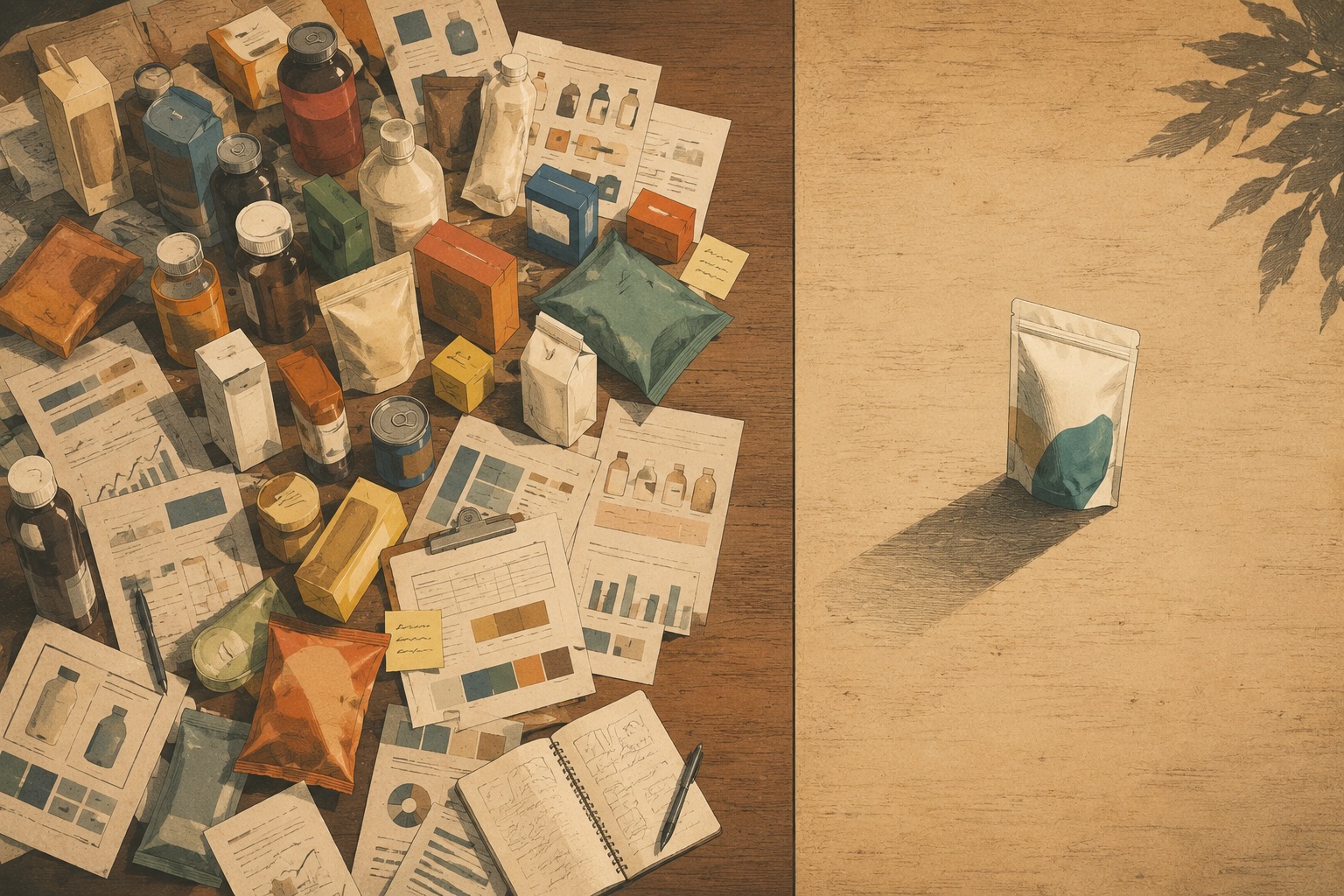
CPG Brand Strategy: Why Most Rebrands Fail Before the Design Phase Even Starts
If you're considering a CPG rebrand, you're probably already frustrated. Sales are flat. The shelf looks crowded. Maybe a competitor just launched something that feels like it should have been yours. So you start thinking about new packaging, a refreshed logo, updated colors. And that instinct makes sense. The problem is visible, so the fix should be visible too.
But here's what 30 years of launching brands has taught me: the packaging is usually the last thing that needs to change. The first thing is the strategy underneath it. And when companies skip that step, they spend enormous amounts of money redesigning something that was never the real problem.
Ready to talk about your brand's positioning? Let's have a conversation.
The Ingredient List Problem (And What It Really Means)
PepsiCo just overhauled Muscle Milk. Cut nearly half the ingredients. Removed artificial sweeteners, colors, and flavors. Switched to ultra-filtered milk as the protein source. Updated the packaging. Launched a new campaign.
On the surface, that sounds like a success story. And the early numbers are promising.
But take a step back and ask the question that nobody in the boardroom wants to answer: what were those ingredients doing in the product for the last decade? If you can remove 50% of the ingredient list and end up with a better product, what does that tell consumers about what they were drinking before?
This is the trust problem that large CPG companies are wrestling with right now. When you announce "cleaner ingredients," you're also announcing that the previous version wasn't clean. And consumers notice.
The Real Reason Rebrands Fail
Most CPG rebrands fail because they start with the wrong question. They ask, "how should this look?" when they should be asking, "why is this losing?"
The answer is almost never visual. It's positional.
Muscle Milk spent years making what PepsiCo described as "smaller adjustments" to meet consumers where they were. Flavor tweaks. Minor reformulations. Packaging updates. Incremental moves that felt productive but didn't address the fundamental positioning gap: smaller, nimbler brands had already claimed the clean-label territory. Brands like OWYN and Orgain didn't have to reformulate. They were built that way from day one.
That's the competitive disadvantage of legacy formulation. You're not just behind on ingredients. You're behind on trust. And trust is not something you redesign your way out of.
Where Smaller Brands Have the Advantage (and Where They Waste It)
Here's what's interesting about the current CPG landscape. Smaller brands have a genuine structural advantage right now. They can launch clean because they don't have formulation baggage. They can position precisely because they're not trying to be everything to everyone. They can move fast because there aren't fourteen layers of approval between an idea and a shelf.
But I watch smaller brands waste this advantage constantly. They come in with a great product and no positioning strategy. They design beautiful packaging that says nothing about why the product exists. They compete on aesthetics in a category where the consumer is reading the back panel before they ever look at the front.
A well-funded startup with the right strategic foundation can launch already optimized for where the consumer is headed, not where they were three years ago when a reformulation project kicked off at corporate. That speed advantage is real. But only if the strategy is right.
Category Strategy Before Design Strategy
When we work with clients at Gel, we typically find that the conversation they think they need to have, the one about colors and typography and shelf presence, is actually the third or fourth conversation. The first conversation is about category.
Where does this product actually live in the consumer's mind? Not where the company thinks it lives. Not where the business plan says it lives. Where does the person standing in the aisle, phone in one hand, actually place this product in their mental map of the category?
That question changes everything downstream. It changes the packaging, obviously. But it also changes the messaging, the retail strategy, the ingredient story, sometimes even the product itself.
Take protein drinks as an example. Roughly 70% of Americans now say they want more protein in their diets. That's up significantly from just four years ago. So every brand is chasing the protein trend. PepsiCo added protein to Doritos. Kraft put it in Mac & Cheese. Pop-Tarts have a protein version now.
When everyone zigs in the same direction, the brands that win are the ones that understood their category position before they followed the trend. They knew what made their product the right version of this for their specific consumer. The ones that just slapped "protein" on their existing product are going to wonder why it didn't move the needle.
The Trust Gap Between Legacy and Launch
I want to come back to trust because it's the quiet factor that determines more purchase decisions than most brand directors realize.
Large CPG companies carry enormous brand equity. Decades of shelf presence. Distribution relationships that took years to build. Marketing budgets that smaller brands can only dream about. Those are real advantages.
But they also carry brand baggage. Every reformulation is an implicit admission. Every "new and improved" is a confession that the old version was neither. And consumers today, particularly younger consumers who grew up reading ingredient lists and researching brands on their phones, they notice the gap between what a brand says now and what it was doing before.
Smaller brands don't have this problem. They have a different one: nobody knows who they are. But the trust equation works in their favor if, and this is the important part, they invest in the strategic work that positions them correctly from day one.
That means understanding your category position before you design your packaging. It means knowing what your brand story actually is, not what you wish it was, but what the product and the market and the consumer all confirm it to be. And it means building your visual identity from that strategic foundation outward, so that every element on the package, the colors, the typography, the claims, the layout, communicates something true about why this product deserves to exist in a crowded set.
What This Looks Like in Practice
We worked with a food brand recently that came to us thinking they needed a packaging refresh. Their product was excellent. Their early traction was real. But they were losing shelf to competitors who, frankly, had inferior products but much clearer positioning.
The temptation was to jump straight to design. But we started with the category work. Who is this actually for? Not "health-conscious millennials," which is what everyone says. Specifically, who. What do they care about that nobody else is addressing? Where does this product sit in their shopping pattern?
That work took weeks. The design phase, when we finally got there, went faster than any of them expected. Because the decisions were already made. The strategy had done the heavy lifting. The packaging just had to communicate what was already true.
The brand launched, picked up major retail distribution, and generated attention that competitors with bigger budgets hadn't managed. Not because the packaging was prettier. Because it was clearer.
The Question You Should Be Asking
If you're sitting on a CPG brand, whether it's a startup or an established product that needs reinvention, the question isn't "who should redesign our packaging?"
The question is: do we actually understand our category position? And does our current presentation communicate it?
If you're not sure, that's the work that comes first. Everything else, the design, the messaging, the retail strategy, flows from that answer. And when you get it right, the downstream decisions get dramatically easier and more effective.
The brands winning shelf space right now, from scrappy startups to companies navigating the kind of overhaul PepsiCo just did with Muscle Milk, are the ones that understood this sequence. Strategy before design. Position before packaging. Truth before aesthetics.
If this resonates and you want to think through your brand's positioning, let's talk.
Frequently Asked Questions
How long does a CPG rebrand typically take from strategy through design? It depends on the complexity, but for most brands we work with, the strategic phase takes four to eight weeks, and design follows over another six to ten. Rushing the strategy phase to get to design faster almost always costs more time in revisions later. The brands that invest in getting the positioning right first tend to move through design more efficiently because the decisions are already grounded.
We already have a clear brand strategy. Do we still need category work before redesigning packaging? Maybe. The test is whether your strategy was built around your internal vision or around how consumers actually navigate the category. A lot of brand strategies read beautifully in a deck but don't map to how people shop. If your product is well-positioned and consumers understand what it is and why it's different, then yes, go straight to design. If sales are flat despite what you believe is strong positioning, the category work is probably where the gap lives.
How do we know if our brand has a positioning problem versus a design problem? If people try your product and love it but you're struggling with trial, that's typically positioning. The product is delivering but the shelf isn't communicating it. If people pick it up, try it, and don't come back, that's probably product. Packaging redesigns fix the first problem. They don't fix the second.
What's the difference between working with a large agency versus a focused firm like Gel? Large agencies bring scale and deep benches. They're excellent for enterprise programs that span multiple markets and products simultaneously. Focused firms bring depth on account. You get senior-level strategic thinking applied directly to your project rather than being handed off to a junior team after the pitch. For most CPG brands, particularly in the mid-market where every dollar needs to work hard, depth tends to outperform breadth.
Is it worth investing in professional brand strategy if we're a startup with limited budget? This is where I'd push back on the framing. It's not an investment you make despite having limited budget. It's one you make because of it. Startups can't afford to launch, discover their positioning is wrong, and relaunch. Getting it right the first time isn't a luxury. It's the most cost-effective path to retail traction. The brands that skip strategy and go straight to design often end up spending twice, once on the initial launch and again when they realize the shelf isn't working.
