What Aguas frescas taught me about brand strategy that wont save you
Why Brand Strategy Alone Won't Save You
Summers always bring out the Hispanic in me. I grew up in North Hollywood, in a Latino neighborhood that spanned blocks, home to immigrants from across Latin America and a small mix of Europeans from Scotland. Grills came out starting Friday afternoon and stayed on porches and backyards until Sunday evening. Everything was ritualistic, from choosing the right meat to the salads that differed from home to home, Chilean to our Mexican neighbors.
It was then that I discovered aguas frescas, visiting my Mexican friend's home, where I saw large jugs of freshly made juice that seemed bottomless all summer. The mothers would proudly compete against each other for the best mix, the most flavorful one. Recipes handed down for generations.
Today, brands like Coca-Cola and Pepsi have their mass-produced versions. They fall short, not just in flavor but in what a real agua fresca makes you feel when you taste something that carries memory in it. That's not something you can formulate in a lab. And it's not something you can manufacture in a brand strategy either, unless everything, the story, the design, the shelf presence, speaks the same language.
If you're working with a beverage branding agency and wondering why your product isn't gaining traction in the US market despite a strong story, this is worth reading. Schedule a conversation with Gel.
The Brand That Had Everything Except Alignment
A few years ago, we worked with Klass Time, Ltd., a Mexican company founded in 1984 in Mexico City. By 2000 they had brought their products to the US to reach the Hispanic community here. Klass isn't just an aguas frescas brand. They make chilito, atole, iced tea, an entire pantry rooted in Mexican food culture.
The real challenge wasn't how to sell any one of those products. It was finding the one idea that could hold all of them together authentically, and then figuring out how to make that idea land with an audience that was changing underneath them.
Because that's the part Klass understood intuitively but hadn't yet named. Their core customer, first-generation Hispanic, deeply tied to Mexican food culture, was aging. And their children, acculturated, bilingual, shopping at Whole Foods and Sprouts alongside the local carnicería, needed something different from the brand. Not a betrayal of where it came from. A translation of it.
That insight became the foundation of everything.
"Drink, Eat, Live Rico"
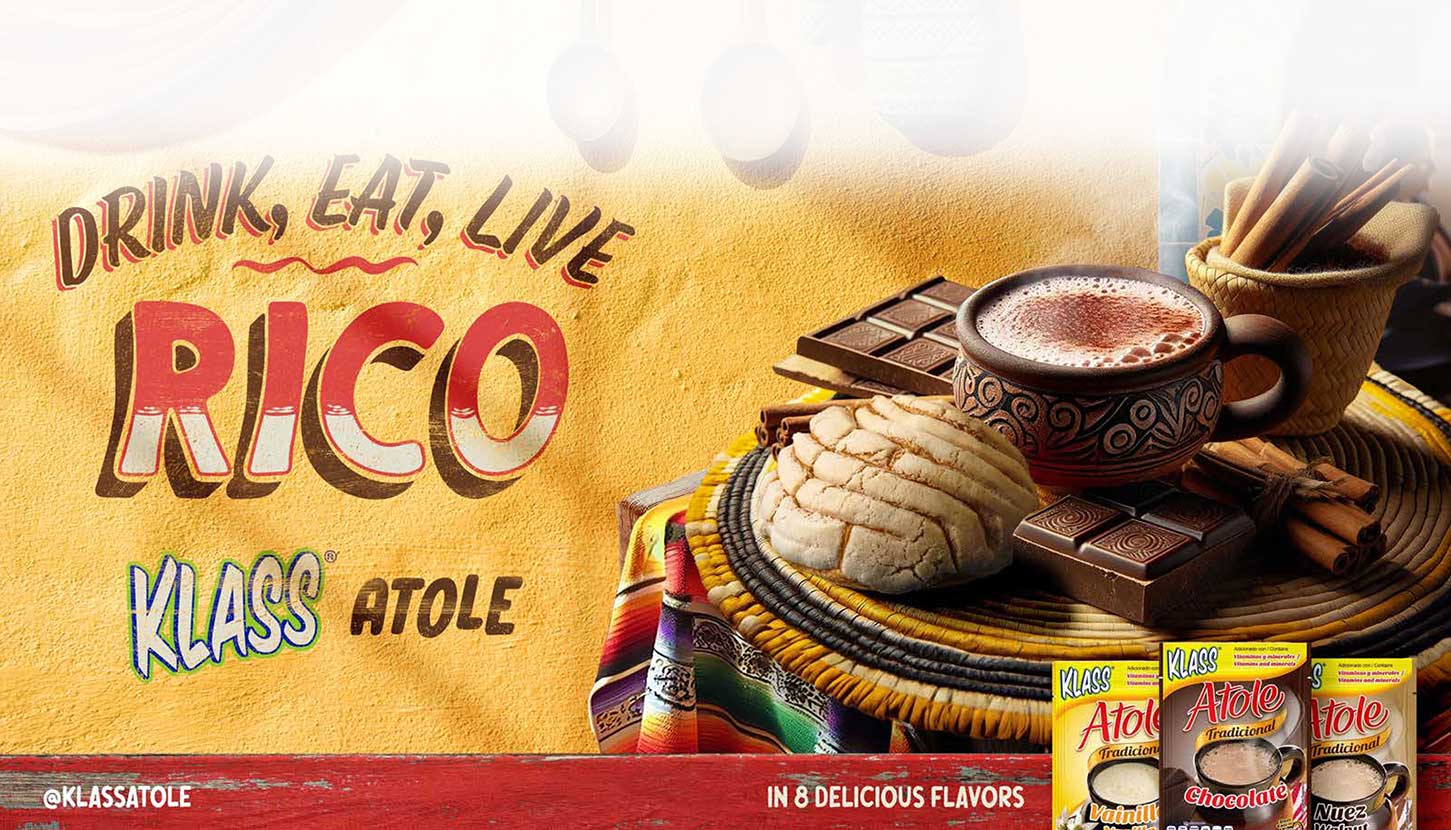
The platform we built together was "Drink, Eat, Live Rico." And Rico isn't just a flavor claim. In Spanish, rico means rich. Rich in taste, yes, but also rich in memory, in culture, in the kind of life you live when food and drink are never just about nutrition or convenience. They're about who you are and where you come from.
A platform like this does something specific. It gives every product in the portfolio a home. The iced tea belongs here. The chilito belongs here. The atole belongs here. You don't have to explain how they're related because the idea does that work for you.
Alongside the strategy we developed a creative vision and art direction framework that gave Klass's team a world to shoot toward. A rooftop pool for the iced tea. A sun-baked street cart piled with fruit and chilito. A warm Mexican kitchen with atole steaming in a clay cup. Every scene different, every scene unmistakably the same brand.
That's what a good platform does. It gives your team the tools to be consistent without you in the room, whether it's a photographer, a social media manager, or someone planning a campaign months later.
Where the Work Ends and the Hard Part Begins
The strategy was complete. The narrative was clear. The creative direction gave the team a world to work within.
What comes next is where most international brands either commit fully or quietly stall. The packaging has to follow. The visual identity on shelf has to speak the same language as the platform behind it. Without that alignment, you have a strategy document and a product that tells a different story the moment someone picks it up in a store.
That gap is more common than most agencies will admit, and it's almost never about resources or budget. It's about something harder to fix: a fundamental misunderstanding of how American consumers decide to buy.
How Americans Shop Is Not How You Think
Here's something international brands consistently underestimate when they enter the US market. Americans research before they reach.
In many markets, particularly across Latin America and parts of Asia, high-frequency selling works. You put the product in front of people repeatedly, you make it available, you push it, and eventually it moves. Familiarity becomes trust.
That model doesn't translate here, at least not with the audiences that determine whether a brand has a future in mainstream retail.
American consumers, and especially younger acculturated Hispanic consumers who sit at the exact intersection Klass needed to reach, want to understand a product before they commit to it. They read the label. They look it up. They check Instagram. They ask whether the brand feels like something they'd be comfortable handing to a friend. The physical package is often the first and only chance to answer all of those questions simultaneously, in about three seconds, on a shelf crowded with competitors who have been refining that answer for years.
If your packaging doesn't complete the argument your strategy started, the research stops there. They put it back.
The Shelf Is the Most Honest Critic You'll Ever Have
No buyer, no retailer, no focus group will tell you what the shelf tells you every single day. It doesn't care about your positioning document. It doesn't know that you spent months finding the right platform. It only knows what it sees, and what the person standing in front of it sees in the two or three seconds before they decide.
This is why strategy and packaging design cannot be treated as separate workstreams with a handoff in between. They have to be developed with the same intent, the same rigor, and the same understanding of who is standing in that aisle and what they need to feel before they reach.
For Klass, the platform was built. The creative world was clear. What the brand needed next was the courage to let that strategy change everything visible, including forty years of packaging that had served one audience well and now needed to speak to another.
That's not a small ask. For a company founded in 1984, with deep roots in how things look and feel and have always looked and felt, it requires a kind of trust that takes time to build. Sometimes it comes. Sometimes leadership gets close and pulls back. Either way, the market keeps moving.
What This Means for Your Brand
If you're an international brand preparing to enter the US market, or a heritage brand trying to reach a younger or broader audience, ask yourself one question before you invest in strategy.
Are you prepared to let the strategy change everything?
Not just the messaging. Not just the campaign. The packaging, the visual language, the way the product presents itself to someone who has never heard of you and will decide in seconds whether they want to know more.
If the answer is yes, the work we do together has a real chance of moving the needle. If the answer is not yet, the most honest thing we can do is tell you that, help you understand what full alignment looks like, and let you decide when you're ready.
That conversation is free. What happens after it is where the real work begins. Let's talk.
Frequently Asked Questions
We already have brand guidelines. Do we need a full strategy before refreshing our packaging?
Brand guidelines tell you how to apply your brand. Strategy tells you whether what you're applying still makes sense for the audience you're trying to reach. If you're entering a new market or targeting a meaningfully different consumer than the one you built your brand around, guidelines alone won't be enough. The strategy has to come first, or the guidelines will just make your current positioning more consistent, which isn't the same as making it more effective.
How do we know if our current packaging is working against us in US retail?
The clearest signal is shelf performance that doesn't match the quality of the product. If you're getting trial but not repeat purchase, the product is fine but the brand isn't building the relationship it needs to. If you're not getting trial at all, the packaging isn't doing enough work at the moment of decision. Both are solvable, but they require different approaches.
Is it realistic to reach both Hispanic and general market audiences with the same brand?
Yes, but only if the brand is built on something true enough to travel across both. Cultural specificity isn't a liability in mainstream retail, it's often an advantage, provided the visual language and narrative are legible to someone who doesn't share the cultural context. The mistake is trying to sand down the specificity to appeal to everyone, which usually results in appealing to no one particularly well.
How long does a brand strategy and packaging refresh typically take for a market entry?
It depends on the scope and how quickly leadership can make decisions, which is often the real variable. A focused engagement covering positioning, platform, and packaging direction typically runs three to five months. Rushed market entries that skip the strategy phase often cost more to correct later than the strategy would have cost to do properly.
How does this land? Be honest with me.
